Third PersonConsulting Talk to us
For project and technology leaders

Your team was trained. The work didn't change.

Third Person Consulting finds out why, so you don't have to. We run your team through a game scenario of the work that matters, such as a go-live, an inspection or a handover, see where the calls go wrong, and fix the process so it holds.

TPC Stress Test readoutBy team

Equipment inspection, 3 sites

Engineering
Operations
Maintenance
New hires
Adoption roadmap18 months

What to keep, fix, stop, start

KSite safety inductionKeep
SOne inspection method, practised on siteStart
XAnnual slide-deck refresherStop
Workshop agendaCross-site best practice
09:00Three sites, three methods: what each one catches
10:00The evidence, and one method to keep
11:00Practice it, then agree the owner
Why "Third Person"

The human perspective AI can miss.

AI can write the procedure, the course and the rollout plan in an afternoon. It works from what's written down. Most of what goes wrong on a project isn't written down.

AI readsthe procedure

We see the step everyone skips, because the gauge is behind a pallet.

AI readsthe training records

We see the new hire who passed the course and still won't ask.

AI readsthe best practice

We check whether the evidence behind it holds, and whether it fits your site.

Six problems?
One problem, three sides.

Onboarding, AI rollouts, technology adoption, training, L&D and process usually belong to different people with different budgets. They tend to fail for the same reason: what the organization decided, what good looks like, and what people actually do have drifted apart. We work on all three sides at once.

One problem, three sides A triangle. Strategy (AI rollout, technology adoption) at the top, best practice (processes, L&D) at the bottom left, execution (onboarding, training) at the bottom right. Between strategy and best practice: decided, but never defined. Between strategy and execution: launched, but never adopted. Between best practice and execution: written down, but not followed. In the middle: the work didn't change. Decided, but never defined Launched, but never adopted Written down, but not followed ONE PROBLEM The work didn't change STRATEGY What you decided AI rolloutTech adoption BEST PRACTICE What good looks like ProcessesL&D EXECUTION What people actually do OnboardingTraining
Test it shows where the sides splitFix it pulls them back togetherKeep it working stops them drifting apart again
What every recommendation stands on

The Best Practices & Standards Database

Our own reference of 1,871 entries: the practices and standards behind every scenario we build and every fix we recommend. Each one is traced to its sources, graded for how strong the evidence is, and labelled with where it stops applying.

How the Database works · 1 minute, with music

What it is

Two parts. Best practices are what tends to work, drawn from published research, accident and project investigations, and industry benchmarks. Standards are what codes, regulators and standards bodies require. They're cross-linked, so a practice points to the rule it supports.

The entries cover the work our clients do: technology adoption and rollouts, projects and decisions under pressure, AI at work, learning and onboarding, construction and quality, civil infrastructure, BIM and data, and workplace safety.

Why it matters

A lot of what gets called a best practice is a vendor statistic, a success story with the failures left out, or a figure that's been repeated so often nobody checks where it came from. If a recommendation can't show its source, you're paying for an opinion.

So we check before we recommend. Where the evidence is strong, we say so. Where it's thin, old or contested, the entry says that too, and so do we.

How an entry is laid out
The practice
One sentence: what to do, and when
Evidence tier
Published research, industry benchmark or regulation, with a confidence level
Sources
The original studies, reports or codes, not a summary of a summary
Limits
Where it doesn't hold: the setting, the sample, the date
Related
The standards it supports and the practices it conflicts with
Updates
What changed since it was first written, and when

Two entries from the Database

LSC-TRF-01Learning science · retires a myth

Retire "only 10% of training transfers"

The figure began as a rhetorical opener in a 1982 trade article. Related "40%, 70%, 50%" figures were training professionals' guesses, and the leading meta-analysis on transfer studied what predicts it, not how much of it happens.

Evidence
Published research
Sources
Georgenson (1982); Saks (2002); Blume, Ford, Baldwin & Huang (2010)
What we do
Leave the number out of business cases, and measure transfer on your own work instead
KIN-TWN-01Knowledge & AI · governance

Treat AI as a consumer of governed knowledge, with citation and abstention

Limit operational answers to approved sources, show the source, version and owner on every answer, and set the tool to say "not found" rather than improvise. Grounding doesn't remove errors: in the first preregistered evaluation, legal research AI tools marketed as hallucination-free were wrong 17 to 33% of the time.

Evidence
Published research, plus research inference
Sources
Magesh et al., Journal of Empirical Legal Studies (2025); Barnett et al., CAIN (2024)
Limits
Legal research stands in for standards and specification work

How it supports the work

01 · Test it

Every decision point in a TPC Stress Test scenario is built on an entry. In the debrief, each call your team makes is tied to the practice behind it, and the readout cites the entries with their evidence tiers.

02 · Fix it

Procedures, job aids and decision guides cite the entries they rest on. Where your situation is a reason to do it differently, we write down why, so the next person knows the departure was deliberate.

03 · Keep it working

Entries are reviewed as new research and code changes come out. Under Managed Learning, when an entry your courses rely on changes, the course changes with it.

Who sees it: the Database is private. Clients see every entry cited in their own work, with its sources. Players of Project: Countdown! can open the evidence behind a practice from the debrief.

How it works: test it, fix it, keep it working

Start with one team and one piece of work that can't go wrong. What the TPC Stress Test finds decides what comes next, if anything.

01 · Test it

The TPC Stress Test

Stress-test the work before it's real.

About 3 weeks, plus a 90-day check

  • A full project scope to find what isn't working, whether it's an AI rollout, technology adoption, training and L&D, or your processes
  • A custom game scenario built on your team's real work
  • One half-day session: your team plays it, then a facilitated debrief
  • A readout: where the calls went wrong, team by team, and three fixes you can act on
  • A one-page "when it goes wrong" plan: the worst case, the first three calls, and who makes them
  • A 90-day re-check: we measure again and tell you what moved
  • A year of access to the full Project: Countdown! platform
  • Your scenario as a SCORM course to keep. It runs in your LMS, or we provide one through our training partner (at the partner's cost)

Our guarantee: three fixes you can act on, or you don't pay.

Book a TPC Stress Test
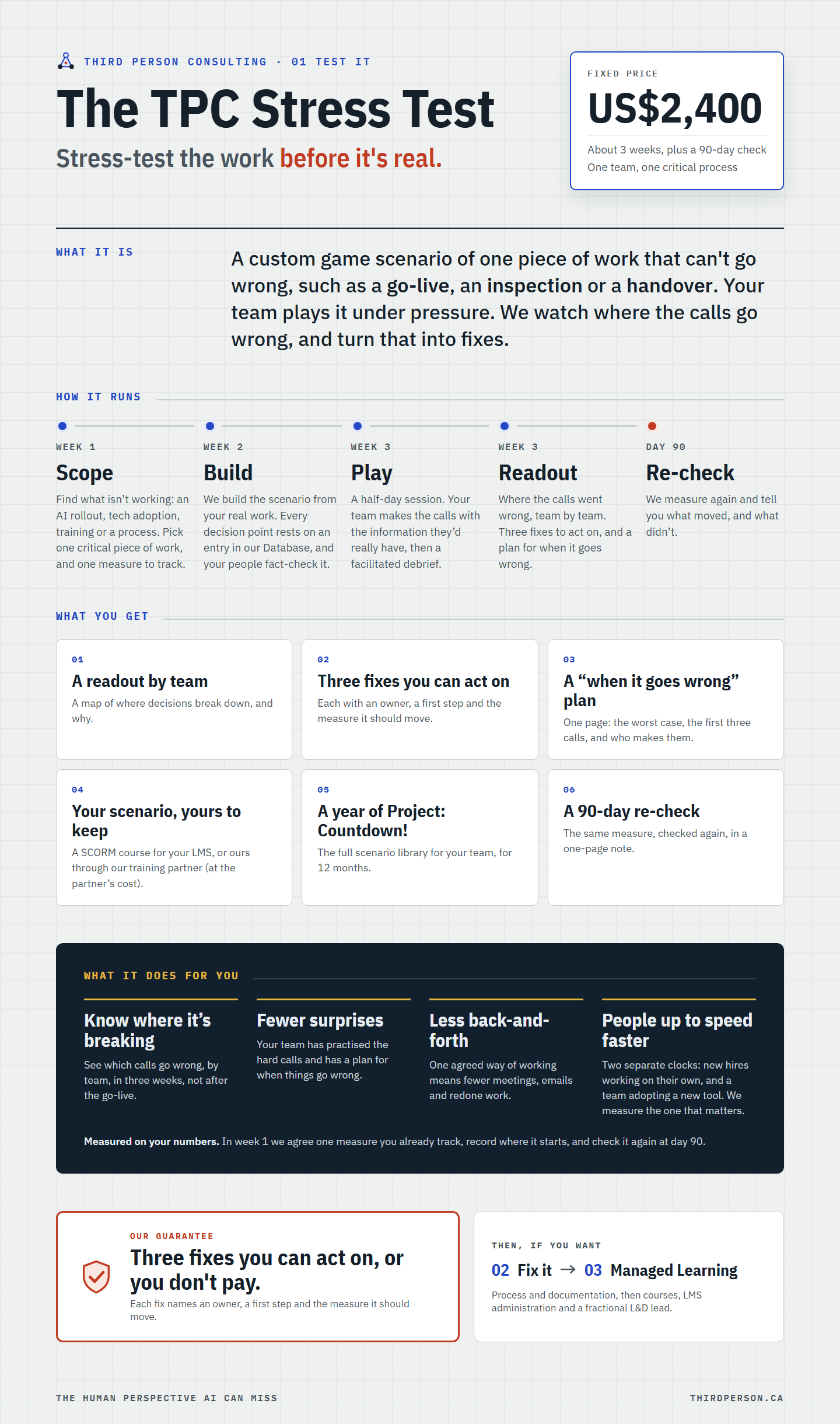
The TPC Stress Test infographic. US$2,400 fixed, about 3 weeks plus a 90-day check, one team and one critical process. How it runs: week 1 scope, week 2 build, week 3 play and readout, day 90 re-check. What you get: a readout by team, three fixes you can act on, a when-it-goes-wrong plan, your scenario as a SCORM course, a year of Project: Countdown!, and a 90-day re-check. What it does: know where it is breaking, fewer surprises, less back-and-forth, people up to speed faster. Guarantee: three fixes you can act on, or you don't pay.
The TPC Stress Test at a glance · Open full size
02 · Fix it

Fix the process

Process & documentation · scoped from what the TPC Stress Test found

  • Diagnose what's wrong: where the process breaks down, and why
  • Identify the best way to do the work, checked against the Database and agreed with the people who do it
  • Recommend and document: clear recommendations, plus procedures, job aids and decision guides people will actually open
Ask about a fix
03 · Keep it working

Managed Learning

Monthly, reviewed each quarter

  • Outsource some or all of your learning: courses built and kept up to date, starting with your TPC Stress Test scenario
  • No LMS to buy, set up or run: we run yours (users, enrolments, reports), or provide one through our training partner at the partner's cost
  • A fractional L&D lead, without a full-time hire
  • A monthly note: what's done, what's next, what's at risk
Ask about Managed Learning

How a session runs: people make the calls themselves, with the information they'd really have. A wrong call costs minutes in a room, not money on site. The debrief ties each call to the practice behind it.

What you get

Measured on your numbers: in week 1 we agree one measure you already track, record where it starts, and check it again at day 90.

From a TPC Stress Test, and the fix

Know where it's breaking, and why

Which calls go wrong, team by team, in three weeks, not after the go-live.

Fewer surprises

Your team has practised the hard calls, and has a plan for when things go wrong.

Less back-and-forth

One agreed way of working means fewer meetings, emails and redone work.

People up to speed faster

Two separate clocks: new hires working on their own, and a team adopting a new tool or process. We measure the one that matters to you.

With Managed Learning

Your learning, handled

Outsource some or all of it: courses, LMS administration and reporting.

Time back

A fractional L&D lead, without a full-time hire.

No LMS to buy or run

We run yours, or provide one through our training partner at the partner's cost.

Who you'll work with

“I don't accept a best practice just because everyone else does.”

I'm Tyler Turek. I started as a historian: a PhD candidate at Western University, where for five years I taught and co-designed an International Relations simulation that put students in the room as the decisions were made, and was named Teaching Assistant of the Year. At Info-Tech Research Group I supported more than 70 IT consulting firms through technology transformations, turning dense research into workshops and action plans their leaders could use. Today I plan training and onboarding on engineering and construction software for enterprise teams representing more than 16,800 learners, in English and French.

In every one of those jobs I watched the same thing happen. A firm buys the software, books the training and checks the box. Six months later half the team still works the old way, the procedure sits unread in a shared drive, and the best practice everyone quotes turns out to be a number nobody can trace. The training usually wasn't the problem. Nobody had looked closely at the work, or at the people doing it.

That's what the name means. A third person sees what the two sides of a project can't: the vendor and the client, the trainer and the trainee, the plan and the crew. I use AI every day to research, draft and build, and I check every source before anything reaches a client. But the judgment calls, the unwritten habits and the reasons people quietly work around a process only show up when someone watches them make the call. That's the human perspective, and it's what we bring.
Tyler TurekFounder, Third Person Consulting Connect on LinkedIn

Our scenarios are built by our studio, Out of Scope Productions, the makers of Project: Countdown!

What's out of step in your work?

Training that didn't change the work, a go-live coming up, or an expert about to retire. Start with a short note.

  • A reply from a person, not a sales sequence
  • A short call to understand the problem
  • A clear proposal, or an honest "we're not the right fit"
What are you interested in?

Send opens your email app with your note filled in. Or write to us directly: [email protected]